How to Generate Leads for a Startup Online in 2025 | Weboin Performance Marketing Chennai
May 26, 2026Performance Marketing
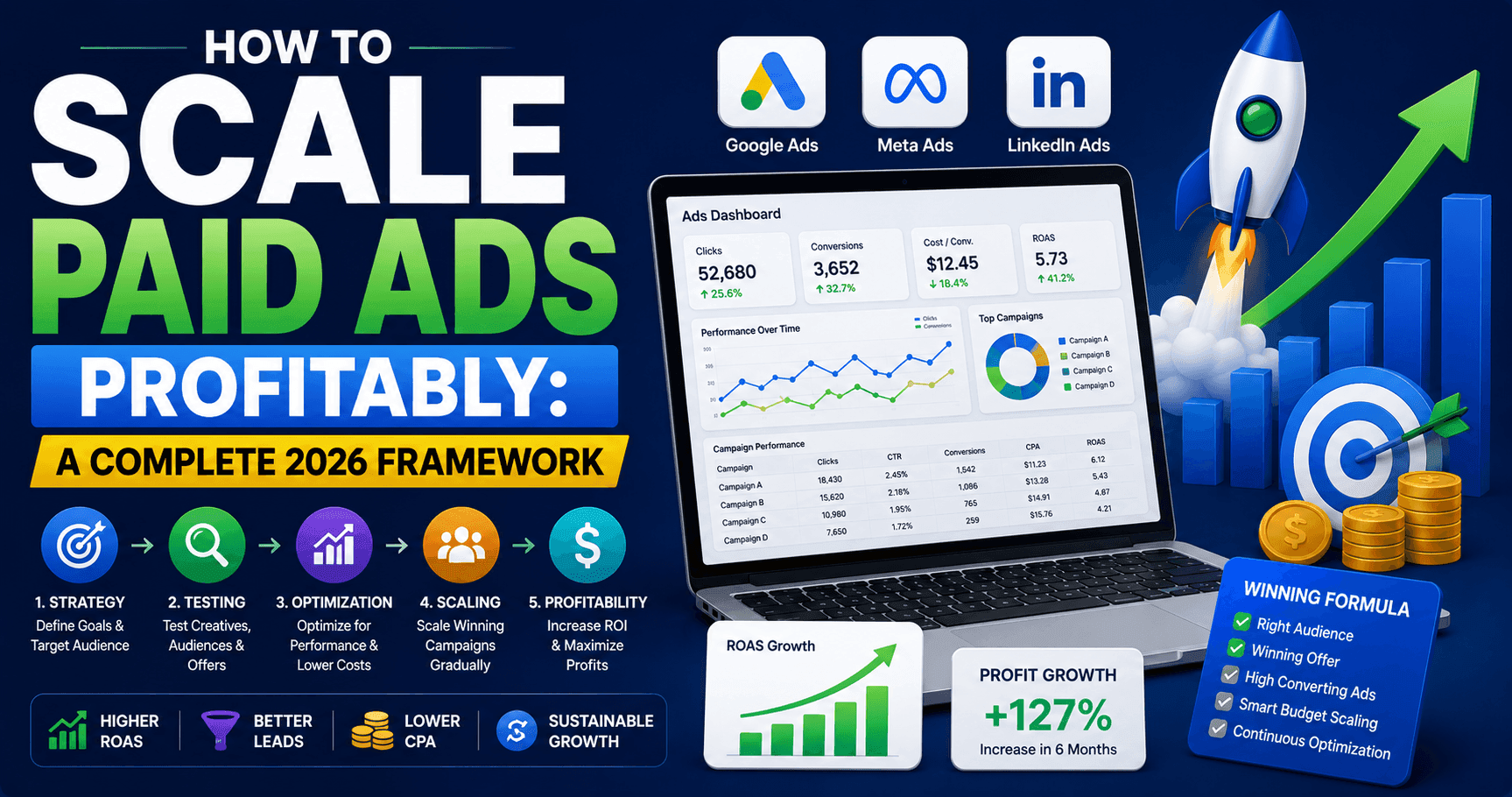
Scaling paid ads profitably requires two conditions to be true simultaneously: your current campaigns must be generating leads or sales below your maximum acceptable customer acquisition cost, and the systems supporting those campaigns — creative production, landing page conversion, sales follow-up, and attribution tracking — must be capable of handling increased volume without degradation. Scaling before either condition is met produces more spend and more leads, but at a higher cost per acquisition that erodes the margin that justified the ad investment in the first place.
This is the most common paid advertising failure at the growth stage. A business finds a campaign configuration that works — a specific audience, ad creative, and landing page combination that generates leads at an acceptable cost — and immediately doubles or triples the budget, assuming the results will scale linearly. They rarely do. Facebook's algorithm exits its learning phase and starts reaching more expensive audiences. Google's Smart Bidding loses the efficiency signal that small-scale precision provided. Creative fatigue sets in faster at higher frequency. Conversion rates drop as the landing page encounters audience segments it wasn't optimised for. Within weeks, CPL has climbed 40-60% and the "winning" campaign no longer looks like a winner.
The framework in this guide prevents that outcome. It covers every dimension of profitable ad scaling — when to scale, how to scale incrementally, how to expand audiences without sacrificing quality, how to maintain creative performance at volume, and how to manage the attribution complexity that scaling introduces. The result is not just more spend — it is more revenue from that spend, at margins that justify continued investment.
Scaling paid ads without the right foundation does not produce more of what's working — it produces more of everything, including what isn't working, at higher cost. Before increasing any campaign budget, verify that all four prerequisites below are met. Each one that is missing will suppress your scaling efficiency.
Your current campaign must be generating leads or customers at or below your Maximum Acceptable CPA (Customer Acquisition Cost). This figure is derived from your business model, not from industry benchmarks:
Maximum Acceptable CPA = Customer Lifetime Value × Gross Margin × Target Payback Period
For a SaaS business with ₹12,000 average annual revenue per customer, 70% gross margin, and a 12-month payback period target:
If your current campaigns are generating customers at ₹6,000 CPA, you have positive unit economics and a ₹2,400 margin buffer — room to scale. If CPA is already at ₹8,500, scaling will push it higher, and every additional customer costs you more than you've budgeted to acquire them.
Scaling budget based on inaccurate conversion data is the most expensive mistake in paid advertising. Before scaling, verify:
Google's own research shows that advertisers using Enhanced Conversions see an average 9% improvement in measured conversions — which means campaigns without it are potentially under-optimising because the algorithm doesn't see the full conversion picture.
Scaling spend increases the frequency with which your target audiences see your ads. Creative fatigue — declining CTR and rising CPL as audiences become overexposed to the same creative — sets in faster at higher spend levels. WordStream data shows that creative fatigue can increase CPL by 25-40% within 4-6 weeks of scaling if new creative isn't consistently introduced.
Before scaling, confirm you can produce:
Doubling ad spend doubles leads. If your landing page converts at 4% and your sales team can follow up within 2 hours at current volume, scaling to 10x spend generates 10x leads — but if landing page conversion rate drops under the new traffic volume or your sales team's response time slips from 2 hours to 48 hours, lead quality and conversion rate will deteriorate precisely when you've invested most in generating them.
Harvard Business Review's research shows that following up with web leads within 5 minutes makes a business 100 times more likely to qualify that lead than waiting 30 minutes. Before scaling, ensure your sales infrastructure can maintain this response standard at the volume you're targeting.
Paid ad scaling falls into three distinct modes, each appropriate for different campaign conditions and objectives. Understanding which mode applies to your current situation determines how to scale without breaking what's already working.
Vertical scaling means increasing the daily or monthly budget on a campaign that's already performing within your CPA targets, without changing its targeting, creative, or structure.
When vertical scaling works:
How to vertical scale without disrupting performance:
The algorithm-friendly scaling rule: increase daily budget by no more than 15-20% every 5-7 days. More aggressive increases — doubling or tripling the budget at once — force Smart Bidding strategies into a new learning phase where performance temporarily degrades while the algorithm recalibrates its bidding model to the new spend level.
| Budget Increase | Algorithm Impact | Timeline |
|---|---|---|
| 10-15% | Minimal; no learning phase reset | Safe to repeat weekly |
| 20-30% | Minor recalibration; slight CPL increase for 3-5 days | Acceptable with monitoring |
| 50%+ | Learning phase reset; significant temporary CPL increase | Avoid unless performance data is very strong |
| 2x+ | Full learning restart; 1-2 weeks of volatile performance | Only in exceptional circumstances |
Practical vertical scaling process:
Horizontal scaling expands reach by targeting new audiences with the same creative and offer that has been proven to convert on the original audience.
Horizontal scaling methods:
Lookalike Audience Expansion (Meta): Create lookalike audiences from your highest-quality conversion data:
Interest and Behaviour Expansion (Meta): If your campaign runs on interest targeting, test adjacent interests that describe the same customer profile approached differently:
Keyword Expansion (Google): Identify high-converting search terms from the Search Terms report and add them as dedicated exact match keywords with their own ad groups — ensuring they receive targeted messaging and appropriate budgets rather than being handled generically by phrase match.
Geographic Expansion: If your business serves multiple cities or regions, replicate your highest-performing campaigns in new geographic markets. Each new market may require localised creative and copy, but the campaign structure and bidding strategy proven in your primary market can be directly applied.
New Platform Scaling: The highest form of horizontal scaling is replicating your proven offer and creative framework on a new advertising platform entirely. A Google Ads campaign generating strong CPL can often be adapted for Meta Ads (which reaches the same audience via interest and behaviour targeting rather than search intent), LinkedIn (for B2B audiences), or YouTube (for video-format engagement with the same core message).
Diagonal scaling — changing both the audience and the creative together — is the highest-risk scaling mode because it introduces two variables simultaneously. If performance deteriorates, you cannot isolate which change caused the problem.
Use diagonal scaling only when:
In practice, the most controlled diagonal scaling approach is to run the new audience with proven creative first (horizontal test), then introduce new creative into the winning audience (vertical creative test), rather than changing both simultaneously.
The central challenge of audience scaling is that the same people who responded first to your ads are typically your highest-intent, highest-converting segment — and as you reach further beyond them, conversion rates tend to decline. The goal of audience scaling strategy is to expand reach while maintaining acceptable lead quality, not to maximise volume regardless of what happens to quality.
Audiences ranked by typical conversion rate and lead quality, from highest to lowest:
| Tier | Audience Type | Conversion Rate Index | CPL Index | Quality |
|---|---|---|---|---|
| Tier 1 | Remarketing — cart/form abandoners | 5x baseline | 0.4x baseline | Highest |
| Tier 2 | Customer match (existing customer emails) | 3x baseline | 0.5x baseline | Very High |
| Tier 3 | 1% Lookalike of purchasers | 2x baseline | 0.6x baseline | High |
| Tier 4 | Remarketing — all website visitors | 1.5x baseline | 0.7x baseline | Above Average |
| Tier 5 | 2-3% Lookalike | 1.2x baseline | 0.9x baseline | Average |
| Tier 6 | Interest targeting (stacked) | Baseline | Baseline | Baseline |
| Tier 7 | Broad targeting (Advantage+) | 0.8x baseline | 1.2x baseline | Below Average |
Scaling sequence: Exhaust Tier 1-3 audiences before moving to Tier 4-5. Move to Tier 6-7 only when higher tiers are genuinely saturated (frequency above 8-10 for the audience size available).
Source quality determines lookalike quality. A lookalike built from your purchasers is more predictive than one built from all website visitors, because purchasers represent the most specific signal of who converts. Best practices:
Meta's Advantage+ Audience removes manual targeting constraints and lets Meta's AI find the converting audience based on creative signals and conversion history. It can outperform manual interest targeting when:
Many businesses running significant Meta ad spend find Advantage+ either matches or outperforms manually targeted ad sets at higher spend levels. It is worth testing systematically rather than defaulting to manual targeting from habit.
Creative fatigue is the most consistent constraint on profitable scaling. At current spend levels, your winning ad might be seen by your core audience 2-3 times per month. At 5x spend targeting the same audience, that frequency rises to 10-15 times per month — and the same creative that felt fresh at low frequency feels intrusive and irritating at high frequency, causing CTR to decline, CPL to rise, and negative feedback rates to increase.
A profitable scaling programme requires a systematic creative production pipeline — not ad-hoc creative production when performance drops.
Minimum creative volume for scaling:
The creative testing framework:
| Phase | Action | Duration | Decision |
|---|---|---|---|
| Launch | Introduce 2 new variants alongside current winner | Week 1-2 | Let each reach 50+ conversions |
| Evaluation | Compare CPL across variants | Week 2-3 | Identify winner; pause underperformers |
| Iteration | Build new variants based on winner's attributes | Week 3-4 | Launch next test round |
| Library | Document what worked and why | Ongoing | Inform future creative briefs |
What to test in creative at scale:
User-Generated Content (UGC) — videos and images produced in an authentic, customer-perspective style rather than polished brand production — consistently outperforms studio-produced creative for direct response advertising at scale. Meta's Creative Research shows UGC-style ads achieve 20-40% lower CPL than equivalent polished brand creative for lead generation objectives.
Why UGC works at scale:
At scale, build a programme for systematically collecting customer testimonial videos: send a structured brief to satisfied clients, offer a small incentive, provide simple recording guidelines (phone camera is fine), and edit lightly to maintain authenticity. This becomes a renewable creative asset that supplements professional ad production.
Each platform scales differently because each operates on a different auction mechanism, targeting model, and algorithm. Budget increases that work smoothly on Google Search may cause significant performance disruption on Meta, and vice versa.
Google Search campaigns scale along the keyword universe. The capacity to scale is bounded by:
Google-specific scaling signals:
| Signal | Meaning | Action |
|---|---|---|
| Impression Share below 60% | Significant reach being left | Increase budget; your campaigns are competitive but under-funded |
| "Limited by budget" status | Budget is constraining delivery | Safe to increase budget immediately |
| Search Impression Share Lost to Rank | Quality issue, not budget | Improve Quality Score before increasing budget |
| CPA stable for 3+ weeks | Smart Bidding has optimised | Safe to raise Target CPA slightly and increase budget |
Performance Max scaling:
PMax scales differently from Search because it distributes budget across Google's entire inventory — Search, Display, YouTube, Discover, Gmail, Maps. At higher spend levels, PMax tends to shift spend toward Display and YouTube inventory (cheaper impressions) rather than converting Search traffic. Monitor:
Meta Ads scales along the audience universe. The capacity to scale is bounded by:
Meta-specific scaling approach:
Campaign Budget Optimization (CBO) — now called Advantage Campaign Budget — is Meta's recommended budget management approach at scale. It allocates budget dynamically across ad sets in real time, concentrating spend on whichever audiences are converting most efficiently at any given moment.
CBO scaling benefits:
CBO scaling caution:
As total paid advertising budget grows, the question shifts from "how much should we spend on this campaign?" to "how should we allocate budget across platforms to optimise total CPL?"
| Platform | Strengths | Typical CPL Relative to Google Search |
|---|---|---|
| Google Search | Highest intent; captures existing demand | Baseline |
| Google Performance Max | Broad reach + AI optimisation | 0.8-1.3x Google Search |
| Meta (Facebook/Instagram) | Largest addressable audience; lookalikes | 0.9-2x Google Search (varies by industry) |
| Best B2B professional targeting | 2-5x Google Search (justified by lead quality) | |
| YouTube | High-reach video for consideration building | 0.7-1.5x Google Search |
| Google Display / Remarketing | Low CPM; broad reach | 1.5-3x Google Search (lower quality) |
Allocate budget based on CPL performance data, not on platform aesthetics or familiarity. The platform generating the lowest CPL at acceptable quality should receive proportionally more budget — regardless of whether it's the platform you're most comfortable with.
Bidding strategy becomes more complex and more consequential as budget scales. The Smart Bidding strategies that work adequately at ₹50,000/month may need reconfiguration at ₹5,00,000/month to maintain efficiency.
Target CPA tells Google and Meta's algorithms to optimise for conversions at or below a specified cost. At scale, the Target CPA ceiling you set determines how aggressively the algorithm bids in each auction.
Common Target CPA mistakes at scale:
Setting Target CPA too conservatively: If you set a Target CPA of ₹1,000 for a customer worth ₹8,000 in lifetime value, you are artificially constraining the algorithm's ability to bid competitively. The algorithm will miss high-converting auctions where the bid required exceeds the Target CPA ceiling, resulting in underdelivery.
Setting Target CPA too aggressively: Setting a Target CPA below what's achievable forces the algorithm to under-bid across most auctions, resulting in dramatic under-delivery and a falsely optimistic CPL calculation from the few conversions it does win.
Finding the right Target CPA:
At scale with multiple campaigns, portfolio bidding strategies allow you to set a single Target CPA or Target ROAS that applies across multiple campaigns simultaneously. Google's algorithm then allocates bids across all campaigns in the portfolio to meet the combined target — borrowing capacity from over-performing campaigns to support campaigns where the target is harder to hit.
This is most valuable when:
The attribution challenge grows exponentially as paid advertising scales across multiple platforms. At ₹50,000/month on a single Google Ads campaign, attribution is relatively simple. At ₹5,00,000/month across Google, Meta, LinkedIn, and YouTube, the same conversion may be claimed by four different platforms in four different reports — producing a combined "total conversions" number that is two to three times your actual lead count.
This is the multi-touch attribution problem, and ignoring it at scale leads to systematically incorrect budget allocation decisions.
| Model | How Credit Is Assigned | Best For |
|---|---|---|
| Last Click | 100% to final touchpoint before conversion | Simple campaigns; single-channel |
| First Click | 100% to first touchpoint | Awareness-focused; brand building |
| Linear | Equal credit across all touchpoints | Long consideration cycles |
| Time Decay | More credit to recent touchpoints | Short purchase cycles |
| Data-Driven (Google) | ML model distributes based on conversion data | Campaigns with 300+ conversions/month |
| Position-Based | 40% first + 40% last + 20% middle | Balanced; good for multi-touch |
Practical attribution recommendation at scale:
Use Data-Driven Attribution in Google Ads (when you have sufficient conversion volume) and supplement platform reporting with a source of truth for actual conversion counts: your CRM. The CRM records where every lead actually came from (via UTM parameters) and how many leads were actually generated — providing the de-duplicated reality against which platform-reported conversions can be calibrated.
Every paid ad from every platform should include UTM parameters in the destination URL, enabling Google Analytics 4 (GA4) to correctly attribute website sessions and conversions to their actual source.
Standard UTM structure:
?utm_source=[platform]&utm_medium=[channel]&utm_campaign=[campaign_name]&utm_content=[ad_variant]
Examples:
With UTM parameters consistently implemented and GA4 properly configured, the Acquisition reports in GA4 show exactly which campaigns are generating landing page sessions and which are contributing to conversions — providing an independent data source that cross-validates (or contradicts) platform-reported conversion data.
A landing page that converts at 6% on 500 monthly visitors may not maintain that rate at 5,000 monthly visitors. Higher-volume traffic often includes wider audience segments, different device and browser distributions, and more geographic diversity — any of which can affect conversion rate in ways that are invisible at low traffic volumes.
When CPL rises during a scaling phase, the first diagnostic question is: has CPC risen or has conversion rate fallen? These have different causes and different solutions.
If CPC has risen:
If conversion rate has fallen:
Landing page diagnostic tools:
Higher traffic volume is an asset for landing page testing — it reaches statistical significance faster and more reliably. At scale, a landing page A/B test can reach 95% statistical significance in days rather than weeks.
Variables to test at scale (in order of typical impact):
Tools for landing page A/B testing at scale: Google Optimize (free), VWO, Optimizely, or Unbounce's built-in testing for landing page platforms.
The profitable scaling tactics that work for an ecommerce business differ from those that work for a B2B SaaS company or a local service business. Each business model has specific constraints and opportunities that shape the scaling approach.
For ecommerce businesses, the primary scaling metric is Return on Ad Spend (ROAS) rather than CPL. The scaling objective is to increase total revenue generated from paid ads while maintaining ROAS above the minimum threshold that preserves profitability.
Ecommerce scaling priorities:
ROAS threshold framework for scaling decisions:
| ROAS | Scaling Decision |
|---|---|
| Below 2x | Pause scaling; fix conversion rate or product margin first |
| 2-3x | Cautious scaling at 10-15% increments; monitor closely |
| 3-5x | Active scaling; increase budget 15-20% weekly |
| Above 5x | Aggressive scaling; consider 20-30% weekly increases |
For B2B businesses — SaaS platforms, professional services, high-value consulting — CPL is less important than cost per qualified lead and cost per closed deal. A campaign generating 100 leads at ₹500 CPL, where 2% close at ₹10,000 average deal value, generates ₹20,000 revenue. A campaign generating 30 leads at ₹1,500 CPL, where 15% close at ₹10,000, generates ₹45,000 revenue. The "cheaper" campaign is less profitable.
B2B scaling priorities:
For businesses operating within Chennai's local market — whether they are independent businesses or branches of larger organisations — geographic scaling is constrained by service area. A dental clinic in Velachery cannot profitably scale ads targeting Ambattur.
Local scaling strategies:
As paid advertising scales, the decision of where to allocate the next ₹1,00,000 of budget should be informed by which campaigns are generating the highest-quality leads — not just the highest volume. This requires connecting your ad platform data to your CRM, so that downstream lead quality and deal conversion data flows back to inform upstream campaign decisions.
Most lead generation businesses have a gap between "lead submitted form" (what ad platforms track) and "lead became customer" (what determines business value). Offline Conversion Tracking closes this gap by importing CRM data back into Google and Meta — enabling the algorithms to optimise not just for form submissions but for the form submissions that actually become revenue.
Setting up Offline Conversion Tracking:
Google Ads:
Meta Ads:
With offline conversion data flowing back to the platforms, Smart Bidding can optimise toward customers who actually close — not just leads who fill in forms. This typically produces a 20-35% improvement in customer acquisition cost within 60-90 days of implementation.
Profitable scaling is not a single action — it is an ongoing operational discipline. The businesses that scale profitably over 12-24 months are those that build systematic processes for reviewing performance, making scaling decisions, and introducing creative into the pipeline on a regular cadence.
Every week, a systematic review of the following prevents scaling decisions based on incomplete data:
Performance check (15 minutes):
Creative check (10 minutes):
Scaling decision (10 minutes):
Next week plan (10 minutes):
Monthly, a deeper review addresses the structural questions that weekly checks cannot answer:
Mistake 1: Scaling before fixing the unit economics Scaling a campaign with CPL at your maximum acceptable threshold will push CPL above it. Fix the campaign — through creative improvement, landing page optimisation, or audience refinement — before increasing budget.
Mistake 2: Increasing budget in large jumps Doubling or tripling budget at once forces Smart Bidding into a learning reset that can take 2 weeks to recover. Scale in 15-20% weekly increments.
Mistake 3: Neglecting creative refresh during scaling Higher spend means higher frequency, which means faster fatigue. If you're not introducing new creative every 2-3 weeks during a scaling phase, CPL will rise not because of the scale but because of the fatigue.
Mistake 4: Optimising for volume when quality determines profitability In B2B and high-value service businesses, the lead-to-customer conversion rate matters as much as CPL. A campaign generating 200 low-quality leads at ₹300 CPL that close at 1% is worse than one generating 80 high-quality leads at ₹700 CPL that close at 12%.
Mistake 5: Scaling on a single platform to its limit before testing others Concentrating all budget on one platform creates structural risk (platform policy changes, algorithm shifts, audience saturation) and misses the diversification benefit of cross-platform presence. Once any single platform reaches ₹3,00,000-5,00,000/month, begin testing the next platform.
Mistake 6: Not adjusting tracking as scale increases At ₹50,000/month, rough conversion tracking is functional. At ₹5,00,000/month, a 15% tracking error represents ₹75,000/month of misallocated budget. Invest in Enhanced Conversions, Conversions API, and offline conversion tracking before scale reaches the point where tracking gaps become significant.
Profitable ad scaling at significant budget levels is where the difference between a professional performance marketing agency in Chennai and an internal team managing ads part-time becomes most consequential. Not because agencies have access to different tools — most are available to any advertiser — but because:
Cross-account pattern recognition: An agency managing 20-30 accounts across different industries sees scaling success patterns and failure modes that no single-account manager encounters. This pattern recognition shortens the time to identify what's causing a CPL increase and what adjustment will address it.
Dedicated creative production: An agency managing scaling campaigns maintains a creative pipeline as a core function. The internal team trying to scale while also managing a product launch or sales campaign cannot produce creative at the cadence that scaling requires.
Attribution and data infrastructure: Setting up Enhanced Conversions, Conversions API, offline conversion tracking, and multi-touch attribution frameworks is a one-time investment that professional agencies make as standard — providing the data foundation that scaling decisions depend on.
Platform expertise currency: Google Ads and Meta Ads change constantly. Performance Max has evolved significantly in the past 12 months. Meta's Advantage+ programme continues expanding. Staying current with these changes — and exploiting new features before they become table stakes — is a full-time function.
For businesses in Chennai evaluating whether to scale in-house or with a professional partner, the right question is not "can our team learn this?" but "does our team have the time, creative resources, and cross-account experience to scale this profitably while maintaining all their other responsibilities?" For most businesses at significant scale, the answer is no.
Working with a digital marketing agency in Chennai or a digital marketing company in Chennai that specifically demonstrates systematic scaling methodology — not just campaign management — is the difference between scaling that compounds profitably and scaling that produces more spend at higher cost.
Profitable ad scaling is not a single decision to increase budget. It is a system of connected disciplines — audience strategy, creative production, landing page optimisation, bidding configuration, attribution accuracy, and operational review cadence — that must all function well simultaneously for scaling to compound rather than collapse.
The businesses that scale profitably to ₹10,00,000/month in ad spend and beyond are not those with the largest budgets or the most aggressive risk appetite. They are those that built the system correctly at ₹1,00,000/month — verifying unit economics, establishing tracking accuracy, building a creative pipeline, maintaining landing page conversion rate — and then scaled confidently because the foundation was strong enough to support the investment.
Every strategy in this guide is actionable at any budget level. The framework applies equally to a startup scaling its first successful campaign from ₹50,000 to ₹2,00,000/month and to an established brand scaling a proven campaign from ₹10,00,000 to ₹50,00,000/month. The principles are the same because the constraints are the same: audience quality degrades at the margin, creative fatigues at higher frequency, Smart Bidding needs stability to optimise, and landing pages need to maintain conversion rate under varied traffic composition.
Build the system. Scale the system. And let the compounding work in your favour — not against it.
For businesses across Chennai looking for a ppc agency in Chennai that manages paid advertising scaling as the systematic discipline it requires — rather than as a series of budget increases — the framework in this guide is the standard to apply to any prospective partner conversation.
Expert digital marketer, copywriter, and developer creating cutting-edge digital growth strategies.
No comment yet, add your voice below!
Your email address will not be published. Required fields are marked *
Get a free, comprehensive SEO audit of your website and discover untapped growth opportunities.
Explore more insights related to this topic